Modern Civilization is Irrational
Modern civilization is based on rationality, but it is not rational.
Most people think of industrial/modern civilization as an expression of rationality, or even as excessive rationality. They see the complex, highly abstract theories of modern science, the complex and carefully designed modern technology that we depend on, and the highly efficient and carefully managed industrial processes that produce everything from toothpaste to cars to hamburgers. Modern civilization seems like a triumph of rationality. The market and the printing press unleashed rationality, and that explosion of rationality created the modern world.
That story is true, but not complete.
Each part of modern civilization is rational in itself, within its bounds. A lot of careful thought goes into the design of a car, a dishwasher or a skyscraper. They aren’t as well-designed as they could be, but they are carefully thought-out. They are also based on empiricism. Knowledge accumulates and is applied to new problems. The designs of cars, dishwashers and skyscrapers are tested, and errors are corrected. Modern technology depends on logic and empiricism.
However, modern civilization as a whole was not designed. It just happened.
Every part of modern civilization was created by human choices: every road, every bridge, every car, every dishwasher, every building, every computer, every circuit on a computer chip, etc. Each part is rational in itself, because it was rationally designed and selected. But modern civilization as a whole was not rationally designed and selected. The aggregate structure of millions of designs is not a design. The aggregate effect of millions of choices is not a choice.
The rationality of the parts does not imply the rationality of the whole.
Modern civilization emerged by an amplifying feedback loop. The growth of civilization is driven by many individual human desires and actions. But civilization needs energy to grow. Modern civilization is powered by fossil fuel energy. Fossil fuels require a large, complex economy to extract and use. They also enable a large, complex economy. As modern civilization expanded on the scales of population, economy and complexity, it was able to extract and use more fossil fuel energy. Growth enabled more growth.
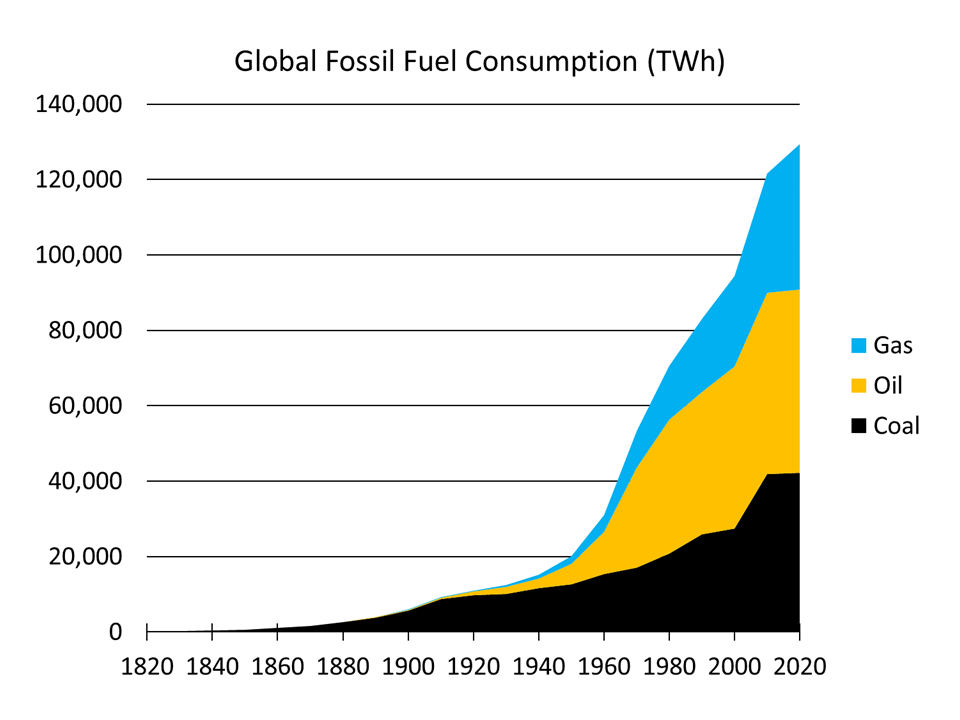
Modern civilization is like a forest fire. Fossil fuels existed in the Earth’s crust for millions of years. That carbon eventually “found a way” to burn. We could say, metaphorically, that it wants to be oxidized. Industrial civilization is a very complex fire, which consumes fossil fuels. Like a forest fire, it finds more fuel as it expands. The bigger the forest fire, the bigger its margins, and the faster it can grow. But eventually, it runs out of fuel. The same is true of industrial civilization. The bigger it gets, the more fossil fuels it can extract from the ground. However, the supply of fuel is not infinite. Eventually, it will burn itself out.
It may seem strange to think of civilization in this way. We normally think of cars, dishwashers, buildings, roads and computers as serving our desires, not as a way to oxidize carbon. We think we are using the carbon, not vice versa. But the system as a whole has been selected to oxidize carbon. Our desires are instrumental to that process. In a sense, we were created by the carbon to have those desires, and to drive the process. Carbon found us, and is using us.
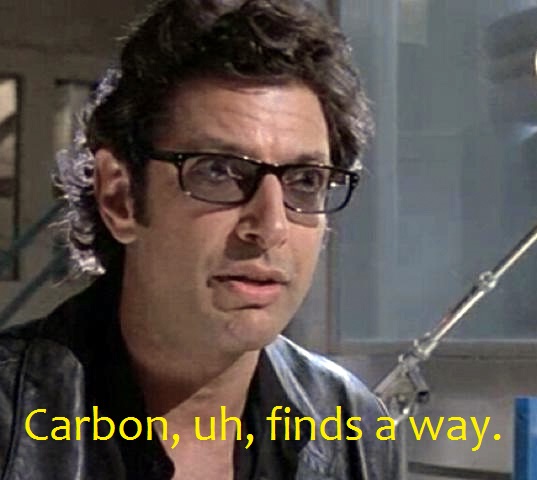
It is a metaphor. But it is a useful change of perspective. And it is no less accurate, and in some ways more accurate, than thinking of modern civilization as a human creation that serves our desires.
Again, we didn’t design modern civilization to do anything.
A technologist designs a dishwasher to wash dishes. A dishwasher company designs its products to satisfy the desires of its customers, and to make a profit. Successful products and companies have been selected by the market mechanism to satisfy the desires of consumers and producers.
None of that applies to our civilization as a whole.
The dishwashers and cars are rational, but the system as a whole is not rational, because it was not designed or selected based on human desires, and it is not controlled by human will.
We could try to make our civilization rational, but that would require a number of things. First, we’d have to understand our civilization and the processes that create it. Then we’d have to develop a long-term collective purpose. Then we’d have to get control of our civilization, or in other words, get control of our destiny, or in other words, get control of ourselves. We would then have to rebuild our civilization based on a design.
To reiterate, we’d have to:
- Develop a collective understanding of our civilization and the historical process.
- Develop a long-term, collective purpose for our civilization.
- Design a civilization that would attain our purpose, based on our knowledge.
- Act together on a global scale to make that design real.
Whenever I propose that we take control of our destiny in this way, idiotic right-wingers start shrieking like little girls about “globalism”, “totalitarianism”, “NWO”, “WEF”, etc. Their implicit assumption is that we can trust nature/history, and that we shouldn’t try to act collectively on a large scale. For some reason, it is okay to act on the scale of the precious nation, but not on the scale of the world or our (now global) civilization.
They are terrified of action, but not of inaction.
But nature/history is not on our side. It doesn’t give a rat’s ass about us. Without action, we are almost certainly doomed.
It might seem like history is on our side, because (for now) we are history’s winners. But that’s inevitable, due to the anthropic principle. Looking backward, it will always seem like history is on our side. Otherwise, we wouldn’t be here to look backward. Looking forward, however, nature/history is not on our side. We have to be clever or lucky to be winners in the next round.
Our civilization is a runaway growth process, not a magical pony-ride to utopia. If we don’t control it, then it will simply burn through its fuel and collapse, leaving behind literal and metaphorical ashes. We can take control of our destiny, or we can be instruments of carbon oxidization.
I think you're onto something.
ReplyDeleteThe current consensus seems to be that, in some way, modern, technological civilization is eternal. Of course, these people are committing the same error that almost every previous civilization committed. They mistake their current arrangement for the permanent condition of mankind rather than just another episode in human history.
Modern civilization is no accident. It is an emergent order almost entirely dependent on fossil hydrocarbons for both its origins and continued existence. Concentrated energy laid down over hundreds of millions of years is currently being consumed to the order of just a few centuries. The curve is well known: Discovery peaks, production peaks, net energy peaks, then the entire structure begins to cost more energy to maintain than it yields.
And contrary to some primitivist fantasies, peak oil will not cause an orderly retreat to a simpler life. It will cause extreme misery. It will result in the total mobilization of every remaining resource in a desperate attempt to keep the system, in the worst case leading to global nuclear war and the extinction of man.
Why? When the oil curve finally turns downward in earnest, most nations won't rationally reject delusional memes such as the humanist memeplex and implement something like e.g. your ideas of eugenic controls and rational, potentially global governance.
ReplyDeleteThey will double down.
They will demand increasingly frantic investments into futile alternative sources of energy, then rationing, then a full war economy, stripping the last accessible metals, burning the furniture to keep the house warm.
Nations that were polite trading partners when oil was 100:1 EROEI will become mortal enemies when it drops to 5:1. Every border, every sealane, every pipeline will become a potential trigger for the final resource wars. Geopolitical rivals cannot tolerate contraction. Therefore they will do ANYTHING to prevent contraction. The result is not difficult to predict:
> First the peripheral states collapse.
> Then supply chains fracture.
> Then the core states turn on one another in a final scramble for the remaining concentrated energy deposits.
> Nuclear thresholds may be crossed because no major power will accept total defeat while they still possess the means of retaliation.
> Either way industrial infrastructure is destroyed or decays mostly beyond repair.
At that point collapse becomes irreversible, not because humans could not in principle rebuild a lower-tech society, but because the ladder has been kicked down. All easily accessible quality ores have already been mined. All near-surface coal seams have already been exhausted. All conventional oil and gas reservoirs have already been tapped or are in terminal decline. You get the picture.
Industrial civilization is a one-shot event in the history of the planet. When it ends, it ends permanently.
ReplyDeleteBut the deeper point is this: even if some miracle energy source were discovered tomorrow, collapse is still dangerously likely.
Because the modern system is already destroying the psychological and social conditions necessary for its own continued existence, with or without hydrocarbons. Calhoun showed that behavioral sink occurs long before resources actually run out. His mice died surrounded by unlimited food pellets because evolutionary maladaptation caused societal disintegration.
I think that's the true meaning of the crisis of the modern world. Not that it is unjust or immoral or ugly. But that it is probably TEMPORARY, and its termination is almost certainly FINAL.
Yeah, that's the great tragedy.
DeleteThe enlightenment unleashed rationality in certain areas: science and technology. Markets and open communication allowed for enormous progress in those areas. But we have not developed greater rationality in other areas. The civilization generated by that progress (modern civilization) is not rational, and is almost certainly doomed, one way or another.
And when it collapses, there is no way to climb back, or at least, it will be very hard, because all the easily accessible resources are gone.
And yeah, if we don't run out of fuel, we'll destroy the biology and culture that civilization depends on. We're using technology to make ourselves insane in various ways.
If you're interested, I have written quite a bit about this topic, especially in the books On the Edge, Immanentizing the Abyss, and Futurist Fantasies.